Product Testing
At Diode Dynamics, we regularly test our own products, as well as products from other brands and suppliers, to provide data to you as the consumer.
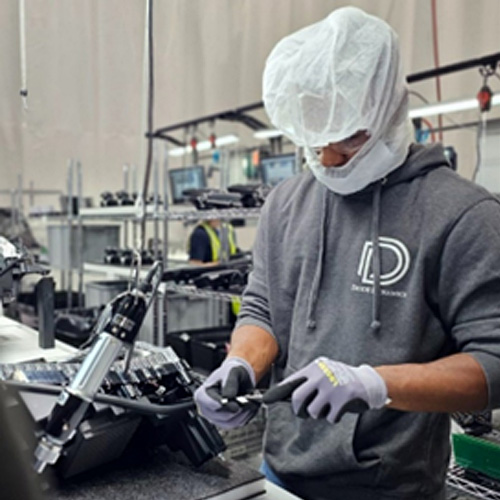
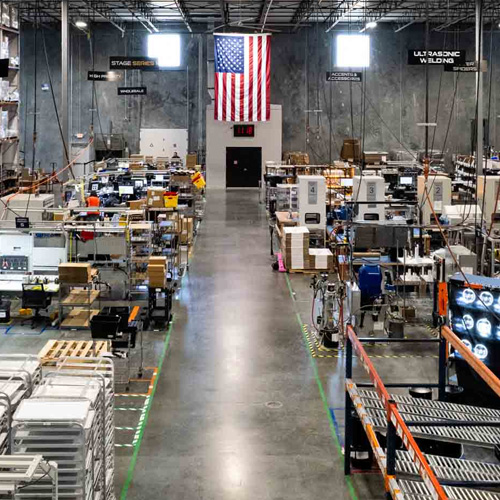
We complete the majority of our product testing in our own in-house lab, which is controlled within the standards of our ISO 9001:2015-certified quality management system. All testing equipment is calibrated regularly and is capable of providing results which are in accordance with relevant regulatory and industry standards. Occasionally, we also utilize qualified third-party laboratories to validate or measure products as well.
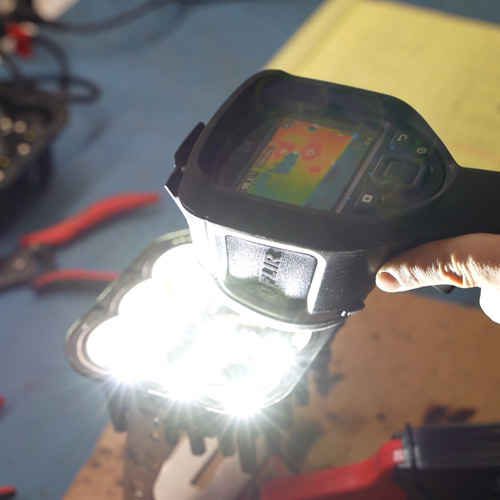
Our measurements are based on established SAE test methods, due to the need to test many of our products to SAE standards. To ensure the greatest possible consistency in measurement, SAE test methods require that measurements are taken after the light source is stable in temperature and output, which usually takes 20-30 minutes in a 25°C environment, without adding any airflow. Unless otherwise stated, this "stabilized" lumen measurement value is the one reported in our content and product specifications.
Since LED light sources provide less output as they heat up, measuring the light prior to stabilization (which may be called "initial output"), or adding artificial airflow to help disssipate heat, can cause much different measurement results. We are aware that many of our competitors do not stabilize their lamps, and may add airflow to help boost performance specifications. We are working to develop new testing methodologies that would account for these factors in a repeatable way.
The most common measurements we collect are as follows. You can learn more about what these terms are in this video.
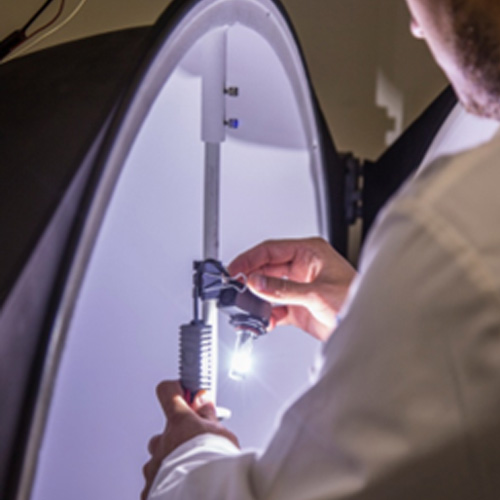
- Luminous Flux (lumens): This is the total amount of visible light coming from a light source, and shining in all directions. It is generally considered the best way to determine total "brightness," however, it does not describe how much light is shining in any specific direction. For this reason, it is normally used only to describe bulbs and other raw light sources - not headlamps, lightbars, or anything that shines a focused beam of light. We recognize that many vendors apply lumen measurements to a variety of lighting products, which is extremely misleading to consumers. We collect lumen measurements with an integrating sphere and spectroradiometer, which is regularly calibrated against a NIST-traceable light source.
- Illuminance (lux): This is how much light hits a specific target or surface in the distance. We measure this by using a lux meter inside a dark tunnel. The amount of light that reaches a target is inversely related to how far the light is shining. For this reason, illuminance, in lux, is always reported with the distance the light is shining. For example, "200 lux at 25 feet."
- Intensity (candela): This is how much light shines from a light source in a specific direction. This is the key measurement for any lamp or light fixture, as it demonstrates precisely how much light is shining in a specific direction. To find intensity values, we shine a lamp in a specific direction, and use a lux meter to determine how much light is shining when the lamp is angled towards that specific point. By taking this measurement at a known fixed distance, we can mathematically convert it to find the intensity.
To automatically measure intensity in every direction light is shining, we use a tool called a goniometer, which automatically points the light source in different directions to measure thousands of individual datapoints. By plotting each datapoint, we can generate a visual representation of the various levels of intensity shining from a lamp. This plot of intensity values, called an isocandela chart, is considered the best way to represent how a lamp shines light across an entire "beam pattern." You can find isocandela charts in many of our product datasheets. Intensity may also be reported as the single maximum intensity measurement observed across the entire beam pattern, called the "Maximum Intensity."
The goniometer and its related equipment is regularly calibrated, and located in a darkroom to capture consistent and repeatable measurements. You can see the process for this measurement here.
We work to provide consistent, repeatable, and accurate measurements in all product specifications and marketing content. If you have questions or concerns about our testing procedures, the data we have reported, or if you would like more information about any specific test or measurement, please contact us at contact@diodedynamics.com