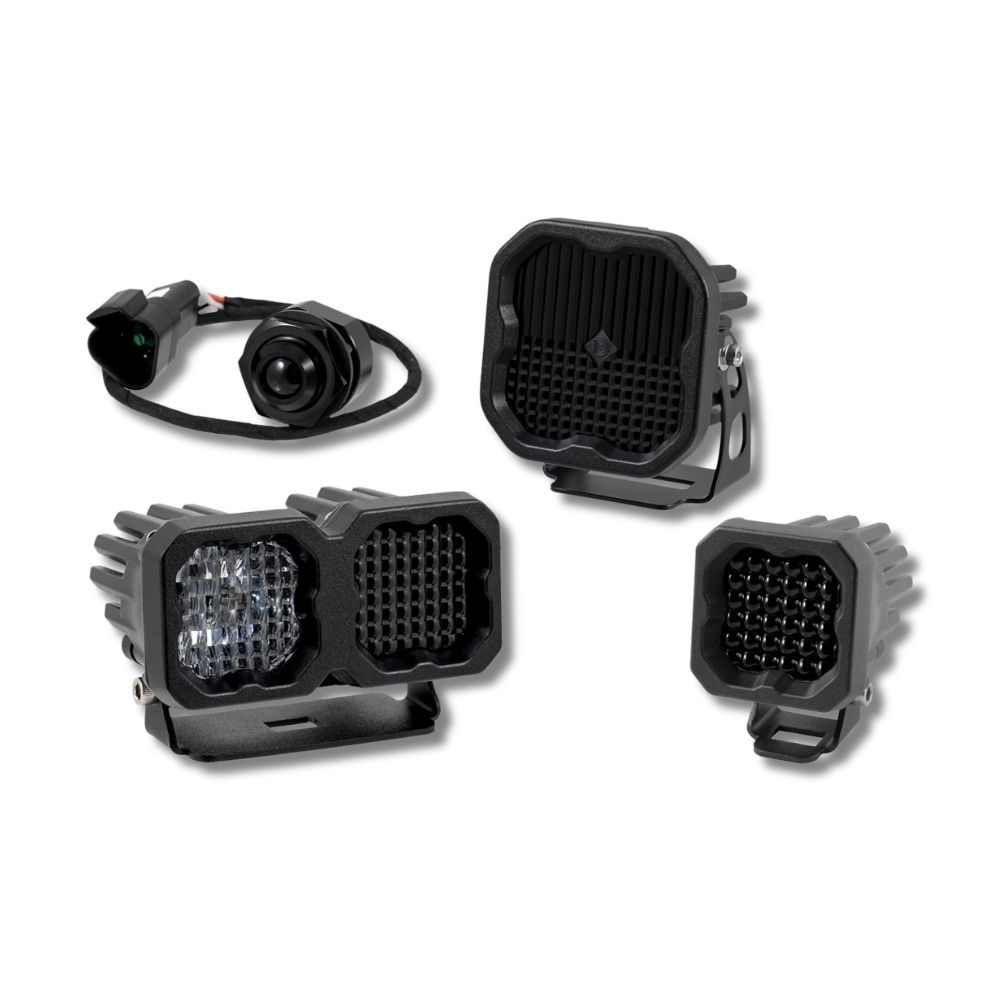
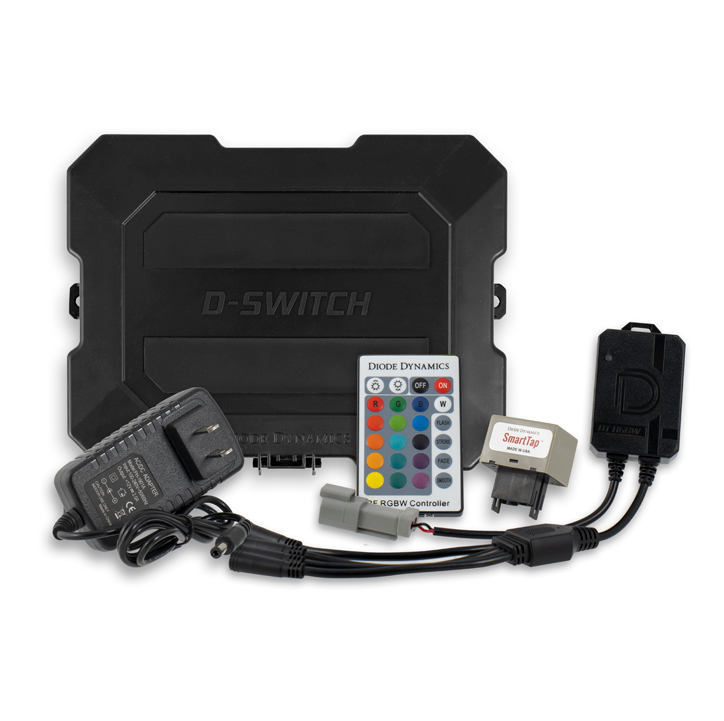
Made in USA
At Diode Dynamics, we are proud to state that the majority of our products are Made in USA with global and domestic materials.
What does that really mean?
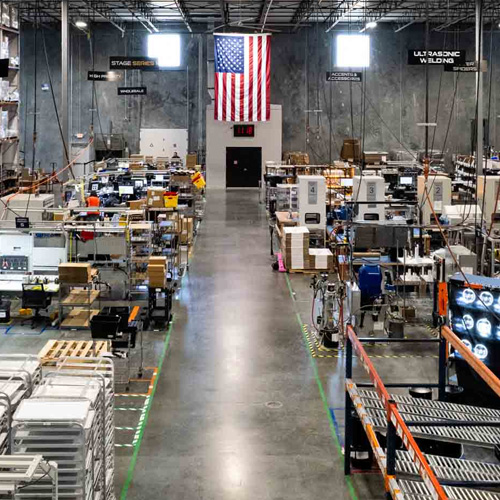
Simply put, there are nearly 40 men and women in St. Charles, Missouri, who build your lighting products each and every day. Your purchases directly support these individuals and their families, and we are grateful for this support.
Since our founding, we have assembled products in-house. We do this because it allows us to control quality, meet customer requirements, and because we believe it's the right thing to do. We've invested more in our production capabilities over the years, as our growth allows. At the same time, we continue to rely on both domestic and international vendors to supply the components that go into our products.
Although we'd love to say our products are 100% Made in USA, on an unqualified basis, it is virtually impossible for any lighting manufacturer to honestly make that claim. To do so, all components, down to the raw material, must be of U.S. origin. Unlike a billet aluminum shifter or straight-pipe muffler, which can be built with only a few input materials, electronic products require hundreds of different components and often include a dozen or more subassemblies. This complexity, along with the different types of components and constantly-changing technology, makes it impossible for any lighting manufacturer worldwide to create all of their own components and finished products in-house.
Let's break it down. What goes into our LEDs, and how much is done in America?
- Circuit boards: 100% in-house. Modern electronics and LEDs rely on circuit board assemblies, which are highly-engineered components and require very specialized manufacturing processes. Since 2014, Diode Dynamics has assembled its own circuit boards in-house. We started with a countertop machine, and today we operate a $1M+ modern surface mount (SMT) circuit board assembly line to handle all of our circuit board needs.
- Electronic components: 30% USA, 70% international. What do we place on the circuit boards? Individual electronic components, such as LEDs, resistors, capacitors, and integrated circuits. Here, it is virtually impossible to find all electronics made in the USA. Many devices are exclusively made in one plant in the world, and they are largely located in East Asia (Malaysia, Thailand, Taiwan, etc). While there is a push to create more semiconductors in the USA, that is not the reality right now, and we must use the devices necessary to reach our goals in product performance.
- Molded lenses and housings: 5% USA, 95% international. Whether it's our OEM-style lamp assemblies or our off-road lenses, we rely on injection-molded plastics. There are many suppliers around the world for plastic components, including many in the USA. Here, challenges exist in the requirements for our parts. A mold house that produces plastic buckets is not the right company to make high-clarity, precision optical components. We currently work with multiple US-based mold houses for certain components, but the "long tail" of our supplies comes from overseas.
- Die-cast components: 100% international. While metal heatsinks aren't too common in OEM-style lamps, they form the core of our off-road line, due to the durability and functional heatsinking performance required for the highest levels of performance. Here too, there are die-casting shops around the world. However, our unique "pin fin" designs, cosmetic requirements, and high powdercoating requirements make that list of potential vendors much shorter. These parts have received "no quote" responses from many prominent die cast shops, due to the high technical and cosmetic concerns. As a result, we are currently sourcing all die castings from international vendors in multiple countries.
- Wiring harnesses: 10% in-house, 90% international. Wiring could be considered a commodity in many ways, but here again, post-processing requirements lead to significant complexity and added cost, especially for suppliers who don't have certain capabilities in-house. For example, automatic double-sided wire strip and crimp machines and overmolding processes are a must for the harnesses we design. Wiring is also extremely labor-intensive, with looming and assembly required, and fast access to specialty connectors, such as OEM-fit plugs, is key. We currently purchase wire harnesses almost exclusively from international vendors, although we produce a few of our own harnesses in-house as well.
- Brackets: 40% USA, 60% international. Sheet metal work has remained in the USA. While we have unique requirements, with full-stainless materials, a tightly-controlled powdercoating process, weldments, and complex bends, we are able to source many of our brackets and sheet-metal components from US vendors. However, many low-volume and some high-volume items are still sourced internationally.
- Hardware: 80% USA, 20% international. We use a lot of fasteners in our products, and thankfully, these are still widely available from US vendors, mostly producing in the US. Most of the full-stainless hardware you'll find on, in, or with your Diode Dynamics product is sourced within the US. Certain customized or specialty hardware is sourced internationally.
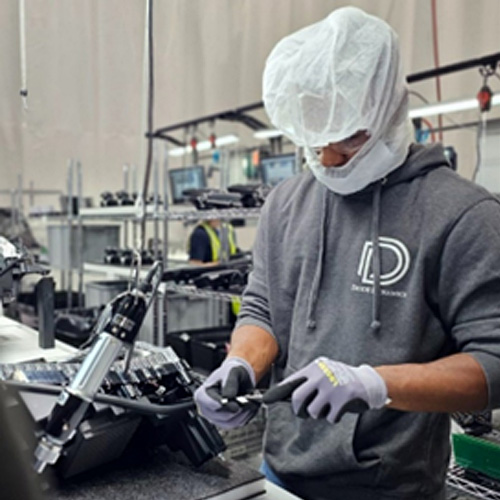
- Manual assembly: 100% in-house. Here's where the work really starts happening. The majority of the work our team does in-house is in physically building your lights. Off-road lights are constructed along a production line using drop-down screwguns, parts bins, test boxes, and other tools, as each light comes together.
- Ultrasonic welding: 100% in-house. All of our smaller lamps, such as sidemarkers, are assembled with ultrasonic welders. With unique tooling and horns for each product, this requires calibration and a close eye to detail, along with regular destructive tests to ensure the weld meets structural and cosmetic requirements. With four ultrasonic welding machines, our team assembles each Diode Dynamics sidemarker in-house.
- Adhesive dispensing: 100% in-house. Larger lamps have to be glued shut. That sounds simple, but in reality, that means a small army of different dispensing robots and pump equipment, designed to handle a variety of different adhesives, encapsulants, and epoxies, depending on the type of product being produced. Each one of these robotic cells has an operator fulltime as well, working alongside to complete the assembly process.
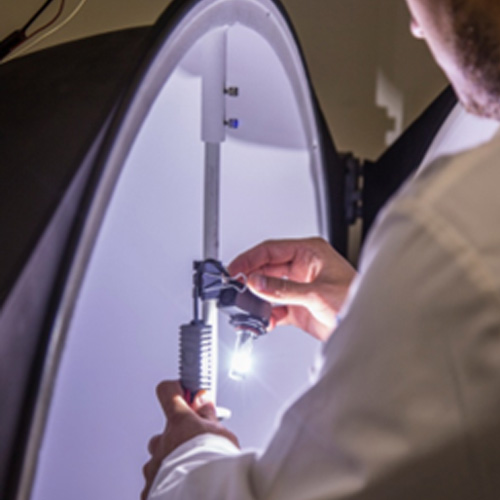
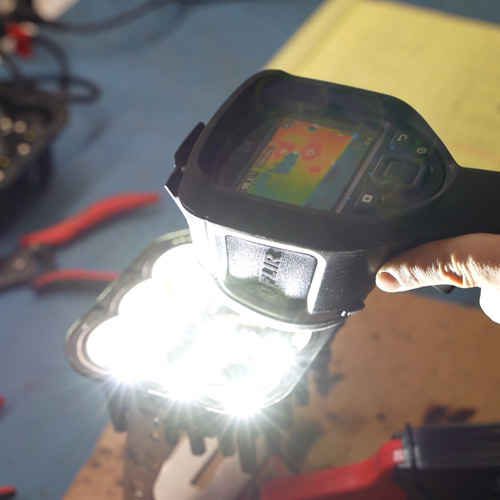
- Aiming and testing: 100% in-house. Every lamp must be tested before it leaves our doors, and many OEM-style Elite Series lamps also require aiming before they're packed up. Our team accomplishes this by testing each and every lamp individually, also using specialized leak-detection equipment to check the seal, and an automotive lamp aiming system, which utilizes a number of cameras to test both lamp function and aim. This tedious process is critical to our success in delivering a highly consistent product to our customers.
- Packaging and Kitting: 100% in-house. Every lamp needs a bracket, and that leads to a lot of packaging, kitting, labelling, and more. With automatic label generation tied into our manufacturing software, we keep things as efficient and accurate as possible. And since we ship our products to thousands of different customers every week, mostly through parcel shipments, the correct protective packaging is a must. While it's nothing too special, we do a lot of packaging at our facility.
We are proud of the work we do in the US, especially as many of our competitors continue to outsource. We remain committed to doing business in the USA. Please check back on this page in the future as our supply chain shifts further to the US. And to see what we do in-house, please watch our Facility Tour.
In reviewing this list, you may think that Diode Dynamics should be able to purchase all of these components needed from US-based manufacturers. That's a fair argument, and we wish we could too. We are constantly looking for opportunities to bring more business to fellow American manufacturers.
In our case, the simple price point is rarely the limiting factor. The true challenge is in our position as a specialty manufacturer. Diode Dynamics is involved in low-volume production. We don't make 100,000 of the same product. We tailor unique lighting solutions to our customer's needs, and with the number of vehicles we serve, there's really no such thing as "high volume" for us. Low volume is difficult for most US-based suppliers. Setup costs, volume efficiencies, and engineering costs are all big drivers. On the other hand, international vendors are often capable of producing short runs with very low setup cost. As a manufacturer working hard to serve specialty applications at low volume, we encourage others to also find ways to become more efficient in producing lower volumes, as consumer needs continue to be specialized, and "custom" becomes the expectation. If you represent an injection-molding, die-casting, sheet metal, or wire harness manufacturer capable of low-volume service, please contact us so we can request a quote.
At Diode Dynamics, we plan to continue bringing more processes in-house to better support our customers, simplify supply chains, and continue investing in our workforce and community. We will rely heavily on technology and software solutions to make it as efficient as possible to build products here in the US, and we are confident that long-term, it is the best approach for our business and our customers.
We thank our customers for your continued support, especially given the complexity and nuance that comes with what should be a simple statement: "Made in USA."